The Perks of Being a Wallflower: Case Study

Since I did some of my research on The Perks of being a Wallflower and my partner and I are taking a lot of inspiration from the film, I decided to do a case study on the movie. The case study will allow me to research and present information on its target audience, production, distribution, marketing, and cross-media convergence. Pretty much research everything about the film from it’s inception to exhibition.
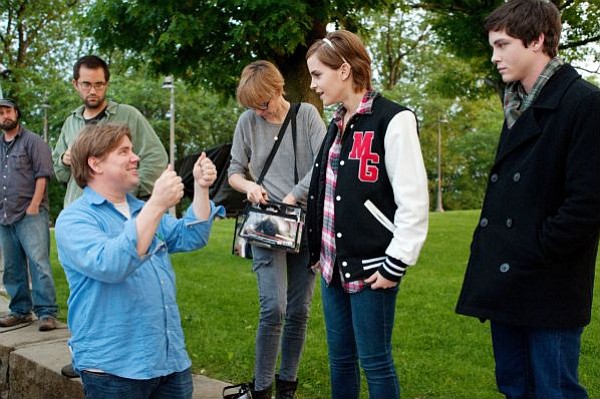
Chbosky with Emma Watson and Logan Lerman (Sam and Charlie)

Starting with the overall history of the film, The Perks of Being a Wallflower initially started out as a novel, like many great movies have been. The novel was released in 1999, and what the main basis for the concept of the movie. After reading an interview on Chbosky about the movie it was cool to see how the director/author casted for the film, explain in a way how the movie got its target audience, and how Charlie was such an impact. Reading on how the director casted for the characters of his films was really interesting and definitely beneficial for future purposes with my film opening. Chbosky said that he knew what he wanted and what he was looking for and when Emma Watson or Logan showed up to the audition it just clicked.

The target audience of the film was definitely and obviously targeted at teenagers in high school and maybe even kids in their early twenties in college. Initially, the film was rated R based on the underage alcohol and drug use while also having a hint of sexual mentions. However, the rating was later changed to PG-13 due to the fact that it had “mature thematic material, drug and alcohol use, sexual content including references, and a fight—all involving teens.” Even though the film had a target audience, the movie spoke to people of all ages and even genders all thanks to the lovable main character. Charlie as a person spoke and related to everyone, even if they were bullied, shy, dealing with mental illnesses or past experiences anyone could relate or empathize at least one part of him.

Researching the production and financial methods of the film, the production of the movie initially began with John Hughes. John Hughes, after reading the novel tried to write a script but never finished. When Mr. Mudd Productions got involved they had Chbosky help adapt the novel to film, adapt the screenplay, and direct. While Mr. Mudd produced the movie, Summit provided the finance for the film and got distribution rights in 2011. The movie was released to a limited amount of areas on Septemeber 1st, 2012 and later had a wide release on October 20, 2012, through Lionsgate. There were also many international releases in countries from Lebanon to Uruguay. Perks then later had a video release through Lionsgate Home Entertainment on February 12th, 2013. During the limited release, the film grossed $228,359, wide release in North America was about $17,742,948, while internationally the film made $15,641,179. In total, worldwide the film made about $33,384,127 in box office.

Marketing strategies of the film include the promotional movie posters and trailers, along with the fact that many of the actors within the movie such as Emma Watson, Logan Lerman, and Nina Dobrev had already starred in many successful movies and/or television shows. Another source of marketing and a thing that helped the movie get an audience was the fact that it was originally written as a novel about 10 years prior, and a pretty successful novel as well. Overall the marketing strategies had a total cost of around 10-12 million.

Sources: Comingore, Aly. “Stephen Chbosky Talks The Perks of Being a Wallflower.” The Santa Barbara Independent – News, 10 Jan. 2013, http://www.independent.com/news/2013/jan/10/stephen-chbosky-talks-em-perks-being-wallflowerem/.

“The Perks of Being a Wallflower.” Wikipedia, Wikimedia Foundation, 28 Jan. 2019, en.wikipedia.org/wiki/The_Perks_of_Being_a_Wallflower.

“The Perks of Being a Wallflower (Film).” Wikipedia, Wikimedia Foundation, 2 Feb. 2019, en.wikipedia.org/wiki/The_Perks_of_Being_a_Wallflower_(film).

“The Perks of Being a Wallflower (2012) – Financial Information.” The Numbers – Where Data and Movies Meet, 20 Sept. 2012, http://www.the-numbers.com/movie/Perks-of-Being-a-Wallflower-The#tab=summary.

Team, Deadline. “Specialty B.O. Preview: ‘Perks Of Being A Wallflower’ Plus Docs ‘Diana Vreeland’, ‘Head Games’, ‘How To Survive A Plague’.” Deadline, Deadline, 21 Sept. 2012, deadline.com/2012/09/movies-coming-out-the-perks-of-being-a-wallflower-diana-vreeland-the-eye-has-to-travel-head-games-how-to-survive-a-plague-340338/.

Stewart, Andrew. “Summit Finds Success with ‘Wallflower’.” Variety, Variety, 26 Oct. 2012, variety.com/2012/film/news/summit-finds-success-with-wallflower-1118061264/.

Adolescent’s First Steps

After performing research on many coming of age films, my partner and I have decided to move onto the next step and briefly screenplay our movie opening. We aren’t really sure what exactly we are going to do yet because during production and eventually onto editing anything could change due to what fits best and what we can actually do. To prepare for changes, we came up with many back-up ideas as to how our movie might open rather than just focusing on one.

Draft for our screenplay of the movie “Adolescent”

In the screenshots above we have a draft of the screenplay for our movie. The screenplay isn’t really focused on shots but rather on the feeling and tone of the overall opening to the film. Besides having just a basic draft of our screenplay, like I said above we have other ideas just in case on shooting day or even when we edit things might not go as planned or turned out as good as we thought. We still want to keep the concept the same but try out different shots and the order that they go in and see what works best and makes the most sense for our movie.

Other ideas we have are to possibly do different shots when introducing the characters. For example when Beck is first introduced we thought about either showing a close up of her playing the guitar then switch to a close up of Jax’s record player as she plays the same song. Another idea for the first few shots would be to show a close up of the guitar then switch to a full body of Beck playing, and perform the same parallel of Jax, or start out with a full body of Beck then switch to a full body of Jax. The filler shot between the first few and the last few shots of our opening is still up for question but in our draft, we are thinking about creating sort of an establishing shot for where Jax and Beck will be next. For the ending, we are pretty much hoping to follow the screenplay and maybe add some more elements within the frame when shooting comes.

Mission Statement: As our film Adolescent is under the coming of age genre, we have a specific purpose for creating our movie. We want our film to achieve an accurate depiction of our youth in a way that we want to represent it. We want teenagers and even young adults to be able to relate to the characters in our film and portray experiences and feelings that we have all went through even if the actions that caused it aren’t the same. Our goal in this film is to fall in love and empathize with the characters and kind of see them as a representation of themselves or how they were. We want the audience to feel as though they are looking back on their youth rather than just seeing the characters experience it during the film.

Sources: “The Internet Movie Script Database (IMSDb).” The Internet Movie Script Database, http://www.imsdb.com/scripts/Perks-of-Being-a-Wallflower,-The.html.

Love Portrayed

In all coming of age movies, a common feature in it is the love the main character portrays for either themselves, family members, significant others, and even their friends. This new found love or love that has a new appreciation usually comes along with their self-discovery. However just like their journeys of self-discovery the love that they gain as well comes with hardships but usually, it grows stronger and is everlasting throughout the movie.

Looking at Ladybird which is the first movie I researched on mainly focused on Ladybird and her mother. The relationship of Ladybird and her mother is rocky during the whole movie, with constant arguments, the mother being too stern, and Ladybird being naive and unappreciative. However, even with the first clip of them sleeping we can see the love that they have for each other. The journey of Ladybird as she learns to accept who she is and where she is from also learns to accept the best person her mother wants her to be. At the end when her mother didn’t speak to her she realizes all that she has done for her and that she was right. She leaves her mom a voicemail and we learn accepts the name her mom gave her.

Then in the Perks of being a wallflower the main love that was portrayed as the love that main character Charlie has for his new friends. As Charlie goes from being a bullied outcast with no friends to a teenager growing out of his shell and finding friends who truly care about him. His friends bring him in when they find out he had none and they take care of him and help him grow. We see the appreciation he has for them as he writes a novel based around them when they asked him too. Another love in the film we see is the love Charlie has for Sam. Even from the first time, Charlie sees Sam we can see that Charlie is in love with him and Sam very slowly starts to love him as well. It begins as an unrequited love to a true love where they both deeply care for each other. We can also see the emotional impact that Sam and his friends have on him as they leave for college and Charlie has a complete breakdown.

While in Heathers a more superficial manipulative love takes place. The fact that it is superficial is simply because in the movie J.D. was never looking out for the interest of Veronica it just seemed like in a way he was using her to kill people he didn’t like. Now for Veronica, she was just simply attracted to him because of his standoffish bad-boy looking. The manipulative nature of J.D. tricked Veronica into killing the main Heather who was the leader of the group, and he kept manipulating her and tricking her to assist him in more killings. The relationship felt more like a fling that any sort of love, and showed toxic relationships that can occur in high school and that many people experience (even though not always to that extent).

Now lastly with The Breakfast Club, the whole portrayal of love is completely different from all the other coming of age films I researched. This is simply because it wasn’t mainly centered around the love of a character towards another, even though there were still some common aspects. The love that is portrayed in this movie is the love that each other the different stereotypes learns to gain towards themselves and others there for detention as well. At the beginning of the film each other the students seem to hate their life in a way and despise the other people in the library as well. However, as the movie goes on they get to know each other and they start to realize that they are more alike than they think and the only thing separating them is the stereotypes society places on them. So at the end of the movie, they all grow an appreciation for each other and realized that they all gained friendships and have grown from the experience. There are more superficial aspects though such as the growing affection Claire gains for Bender and that Andrew gains for Allison. We can also see as well that Bender causes Claire to begin to go through a sexual awakening.

Heathers

Heathers is a coming of age film released 1989 and was directed by Micheal Lehmann

Opening Scene & Title Sequence:https://www.youtube.com/watch?v=kupuUVYxZxU

The opening scene and title sequence of the coming of age film “Heathers” begins with a black screen and a cursive font, giving more of the vintage fancy appeal with a white and pink tint. The title sequence then switches to a series of close up, establishing, and tracking shots on three girls. The titles begin center framed but as the scenery changes the placement of the title switches from each corner of the screen. The opening scene has a song playing in the background that adds to the rich girl feeling as they go on to play cricket. Not much continues to happen throughout the scene, except we learn that the three girls names are Heather and the main character who is stuck in the ground is the girl who seems particularly out of place within the group.

Heathers is a movie about a girl named, Veronica who is apart of the most popular clique in her school, but she disapproves of their cruel behavior to other students. Veronica meets a new kid at her school (J.D.) and eventually, they start dating. J.D. tricks Veronica into poisoning Heather. Veronica then later realizes in the film that J.D. is killing people he doesn’t like so Veronica tries to stop him and the new Heather in charge.

Even though Heathers is still a coming of age film, it is very different from the other films previously talked about in my blog. The movie is more of a dark comedy and a cult favorite than other coming of age films such as The Breakfast Club or the Perks of being a wallflower. In a sense, Heathers is like a really messed up, older version of mean girls. The film mainly focuses more on teenage angst than nostalgia which is usually present, and this angst is comedic through the fact that they use serial killing to highlight it. The satirical tone to the movie also exaggerates teenagers unusual and often twisted justice system.

The main genre conventions present begins with the fact that Veronica was adopted by “The Heathers” which is the most powerful group at their school. Veronica tries to conform and fit in with the girls’ cruel ways but eventually, shes had enough and hooks up with J.D. This is where Veronica experiences a sexual awakening and also goes through manipulation that causes her to help J.D. kill people at their school. The movie focuses on teenage angst and the overdramatic ways in which teenagers act towards each other. Veronica tries to first fit in with Heathers and then J.D. when she ends up disagreeing with both of their ways she finds herself and learns to become independent. While on her journey to being independent she also learns to take down and outgrow Heathers and J.D. which were weighing her down extremely before. Then iconically at the end of the film and J.C. blows himself up Veronica stands at the stairs with a cigarette watching the explosion and later smokes when they explosion lights her cigarette. This is a more gruesome way of showing a teen being exposed to smoking during a coming of age film but it still follows that main genre convention that is seen.

Location: The location of the film was set to be in Ohio in the movie, but all the scenes were shot at Los Angeles between a mixture of two high schools. The main scenes of the movie were at school or at one of the Heathers houses.

In total the main reason as to why I chose this movie as a part of my research is the fact that it had more grunge, cult film feel to it. My partner Scarlett and I wanted a grunge sense to our film opening, so I thought researching this movie was the perfect inspiration for us. One thing I particularly liked about this movie, besides the fact of the dark and blunt humor was the color schemes and meanings. Each character and the color scheme focused around four colors, red, blue, yellow, and green. Heather C, the leader, is in all red from her clothes to her house which shows her source of power and how the power is transferred when Veronica receives her scrunchie at the end. Yellow which is Heather M’s color shows that she is the nicer girl out of the bunch, while the third Heather is in green mainly because she’s jealous. Veronica, however, is in blue which contrasts mainly with the leader Heather’s red and the intensity of Veronica’s color grows as she breaks free of the heathers.

Sources: “Heathers.” Wikipedia, Wikimedia Foundation, 28 Jan. 2019, en.wikipedia.org/wiki/Heathers.

McPadden, Mike. “Everything Millennials Need To Know About The ’80s Cult Classic Heathers.” VH1 News, 17 Mar. 2016, http://www.vh1.com/news/251760/heathers-explained-to-millennials/.

Viviehn. “CHROMATALK: Heathers, or Why Color Matters.” Mostly Harmless, 9 July 2016, viviehn.wordpress.com/2016/07/09/chromatalk-heathers-or-why-color-matters/.

The Breakfast Club

The Breakfast Club is a coming of age film, released in 1985 and directed by John Hughes

Opening Scene and Title sequence: https://www.youtube.com/watch?v=tUN-8TvevGU

The opening scene and title sequence of The Breakfast Club again opens with a black screen and the iconic song “Don’t You (Forget About Me). The font is centered but slightly larger than in most coming of age films I researched, and the color is yellow. The title sequence is then followed by a quote by David Bowie on a black screen that goes along with the underlying theme and meaning of the movie. The transition from the title sequence to the opening scene is very unique for the fact that the screen is shattered as if something broke it, giving the feeling you’re breaking through a barrier. Nothing much happens in the opening scene in the beginning except an establishing shot of the school, and then individual shots of objects that make up the school, and the stereotypes present within it. Throughout the shot an interior monologue of one of the main characters. The shots then focus mainly on the stereotypes of the main characters as well when they are being introduced.

This iconic coming of age movie in a whole is about five students all of different stereotypes that are portrayed on them. There is the brain, the athlete, the princess, the outcast, and the rebel. Each character has his or her own chance to tell their story from their own personal perspective showing their differences but at the same time bringing them together.

The Breakfast Club I would say is one of the more artistic coming of age films in a way, in a sense that it has such a deeper and thought out meaning than most films. The main genre conventions used in the movie are the extreme exaggeration of the stereotypes of the main characters. They are all total opposites of each other in many ways. So instead of focusing on one stereotype character and how they don’t fit in, it’s mainly about all these different stereotypes and how they are oppressed and created by society. The self-discovery among the students that is made within the film is the fact that the students learn that even though they are different it is society that is creating the barriers between them in that way. They learn that the differences between them are created and placed upon them by society, and it highlights those differences versus who they really are. All of the characters in the film come together, become good friends, and learn to understand each other. They all smoke marijuana which during the film kind of seems like a form of communion for the group and is kind of a turning point for the group’s relationship.

Location: The filming of the movie took place at Maine North High School in Des Plaines, Illinois. Again the theme of a small town high school is present within this movie and the whole movie is literally shot at the high school at the main characters go to Saturday detention.

The main aspects of the movie that I liked the best were the fact that the whole movie as I stated before is really artistic in a way that makes the theme of the movie stand out. The movie highlights the issue of stereotypes and how much society oppresses teens through their views. The whole movie is about each character representing a stereotype coming together and realizing who they really are versus who society portrays them to be. The sense of coming together between such different individuals and the self-discovery that they go through creates the nostalgic feel of the movie. From the letter written at the end to the iconic raised fist of the rebel shows the journey they overcame in a such a short day which causes them to question if they will ever view high school the same again.

Sources: “The Breakfast Club.” Wikipedia, Wikimedia Foundation, 29 Jan. 2019, en.wikipedia.org/wiki/The_Breakfast_Club.

The Perks of Being a Wallflower

The Perks of Being a Wallflower is a coming of age film directed by Stephen Chbosky

The opening scene and title sequence of the perks of being a wallflower start out as a completely black screen with white lettering. The font of the lettering looks like the font used on a typewriter, and as the credentials pop up the typing and sounds of the typewriter are playing in the background. As the title of the movie is displayed it then switches to what in a way is an aerial shot of the city but the scene is of what is seen from the back of a moving vehicle. Not much happens within the first two minutes of the film, besides the continuous aerial shot of the city from the vehicle. The credentials are center framed in the middle of the shot and still continues to have the intentional typewriter font.

The perks of being a wallflower is overall about a teenage boy named Charlie who is becoming a freshman in high school. Charlie doesn’t really belong anywhere and in the beginning, has no friends. His isolation and solidarity is pinpointed extremely when he sits by himself at lunch and gets bullied consistently.

The main genre conventions present in coming of age movies that are in this film is the fact that Charlie is isolated and doesn’t fit in with anyone as stated previously. He does, however, find a friend group that really bring him out of his shell and make him the happiest he’s ever been, although the film has a darker subject than others. At this time when he finally makes new friends we see Charlie begin to open up, have more fun, and try new things. Charlie begins to try things such as drinking, smoking, and even tries drugs as well at parties with his friends. During the movie, we learn that Charlie struggles with depression and suicide because of the sexual abuse he experienced by his aunt. Even though he still has these difficult issues we still experience what starts out as unrequited love between Charlie and Sam which then turns into an emotional and sexual awakening between the two. Charlie’s love for his friends is also shown and expressed deeply as well.

The location of this film was shot in Pittsburgh, Pennsylvania with some few scenes filmed in Upper St. Clair. The location again gives the small town feel that is typical in coming of age movies, and what mainly gives the reminiscent feeling. The main scenes in the film were more grunge in a way due to the fact that many of it was at parties, school, his house, or at a movie theater recreating rocky horror picture show. The characters were misfits, listened to rock music, had a grunge feel but were normal everyday people in a sense.

The main aspects of this film that I love are the fact that the nostalgic feel is overpowering, it stands out and slaps you in the face. Watching the movie I felt deeply attached to the characters, experiencing the emotions they felt and is very empathetic to the main character as he grew as an individual. The movie showed the darker experiences of a high school experience because every character in the movie had gone through something to make them the way they were. The movie was so realistic, it felt like you were there with them the whole time. It has definitely become one of my favorite movies EVER.

Sources: “Six Pittsburgh Film Locations For The Perks of Being a Wallflower.” LocationsHub, http://www.locationshub.com/blog/2013/10/27/six-pittsburgh-film-locations-for-the-perks-of-being-a-wallflower.

Lady Bird

Lady Bird is a coming of age film that came out to theaters in 2018 and was directed by Greta Gerwig.

Lady Bird Opening Scene: https://www.youtube.com/watch?v=wVKPQ9iZ04I

Lady Bird Title Sequence: https://www.youtube.com/watch?v=T5VI3dng9dA

Looking at the opening scene of Lady Bird, it takes a really simplistic and minimalistic approach for its cinematography. The scene starts out silent until soft dialogue comes in. The whole clip is a series of two shots of Lady Bird and her mother, which then eventually as conversation picks up single shots back and forth between the two. The opening scene lacks a title sequence, the title sequence came after the first two minutes of the film after Lady Bird was introduced. The names were centered on the low end of the screen and matched the overall color palette of the movie.

The film location for this movie was shot in Sacramento, New York, and Los Angeles. Mainly the movie was shot at her school, at her house, and eventually in New York where she finally attends college. The reason being for these main locations is the fact that as teenagers your life mainly revolves around your home and school, and also side things such as jobs, your friend’s house, or pretty much wherever life takes you at the time.

The main genre conventions of coming of age movies that are present in this film are the fact that Lady Bird starts out naive, embarrassed about who she really is, trying to be something she is not and goes through a sexual awakening. Lady Bird throughout the whole film pretty much is naive and in a way ignorant about how her actions affect others especially her mother’s feelings. She begins being embarrassed about where she lives and the money problems her family has. She lies about where she lives to become more popular and befriends the most popular girl at school. This is where she tries to be something she is not and throughout this time goes through a sexual awakening as well. Later on in the movie, as Lady Bird goes off to college she is also opened to drinking at a party where she quickly gets drunk and does the popular puking scene which is seen in many coming of age films as the characters try new things.

Overall one thing that really drew me to this movie was the simplicity in it that still made it complex at the same time. The feeling of the movie was very simplistic but a lot of events occurred at the same time, kind of like how life is in your youth. One thing I loved, in particular, was the director’s reasoning for her color scheme and the overall feel of the movie. Gerwig explained how she wanted the movie to be like a memory, so in a way, you’re connected but disconnected to the film as well. Greta did this by getting her inspiration from yearbook photos in which she ended up making the film have a grainy distressed feel to it. The fact Gerwig wanted the film to be like a memory tied the whole nostalgic feel together, and in fact made it even stand out more because everyone reminisces on their adolescence.

Sources: O’Falt, Chris, and Chris O’Falt. “How Greta Gerwig’s Brilliant Use of Colors Turned ‘Lady Bird’ Into an Emotional Nostalgia Trip.” IndieWire, IndieWire, 14 Dec. 2017, http://www.indiewire.com/2017/12/lady-bird-greta-gerwig-color-sam-levy-1201907175/.

Adolescent Introduced

As a media studies student, I decided with my partner Scarlett Hubbi to create the opening scene of a coming of age film. We liked the concept that a coming of age film had, teenagers finding themselves or are opened to adulthood in some way simply because we are teenagers as well, so the idea to us was really neat. So we decided to follow the common trait of the main character/character’s finding themselves and name our final film project “adolescent.”

Starting some research on the genre I realized that coming of age film’s have a common theme but the overall aesthetic can be very broad-based on what the director wants the audience to feel while watching the film. Nevertheless, the genre does have a common theme and goal that they want the audience to grasp. These films are mostly set in the main characters adolescence and it focuses on major changes that can cause the character to change his/her perspective and in a sense grow up. Coming of age movies show us things we have all experienced in our youth or will experience someday, and the main component that ties all these films together is nostalgia.

Main Genre Conventions: The main genre conventions of coming of age films are beginning with the fact the almost in every movie the character’s are in their late childhood or teenagers about to become adults. The protagonist or main character often goes from being nieve to now self-discovered. Along with their need to find one’s identity, they are also embarked on a “sexual awakening” which typically stands in the way of many decisions along their emotional journey.

The main characters also begin to try and are open to new things such as smoking (mainly cigarettes or marijuana), drinking, and in even some movies drugs. When it comes to smoking the two main things in a coming of age film you will see is marijuana and cigarettes. Many films such as The Breakfast Club, The Perks of being a Wallflower, and Dazed and Confused show marijuana. While other movies such as Heathers and The Fault in our Stars features smoking a cigarette. As for drinking though, the type of drinks doesn’t necessarily matter as much as what comes after it. In many coming of age films such as Heathers or Lady Bird, the main characters get drunk at a party and later on throws up pretty much in front of everyone. This humiliation and kind of bad side shown to partying is seen many times in these type of films because in real life and even in that movie it is like a learning experience for the main character.

Coming of age films can be very light-hearted and funny as well but what stands out is the emotional feeling that sticks with you after the film, and the fact that the characters journey has a deeper meaning. Topics present in coming of age films can go from being very carefree such as self-discovery, finding one’s identity, and unrequited love. While on the other hand, some films can touch rather darker subjects such a suicide, depression, and even family issues.

The main characters in the films are often different compared to the people around them, they don’t really fit into any social group at the beginning of the film. The protagonist’s isolation and lack of their identity are highlighted significantly, and throughout the film, they struggle and desire to fit in so bad. They often in the movie try to assimilate themselves to be something their not leaving their real friends behind until something happens that causes them to be lonely once again.

Audience: The target audience for coming of age films is teenagers to people in their early 20’s. This is because this type of audience can relate most to the movie since it is about the time of their lives where they are or have experienced the same things as well. This is how we will get people to watch our movie by including features that will really hit home with them because everyone loves a good emotional story especially when love of some type is included as well.

Sources: Hellerman, Jason. “50 Best Coming of Age Movies with Writing Tips [FREE Checklist].” No Film School, 16 Oct. 2018, nofilmschool.com/best-coming-of-age-movies.

“Coming-of-Age: Genre Format Series (Working Title) Extraordinaire.” Raindance, 3 Aug. 2018, http://www.raindance.org/coming-of-age-genre/.